What Size Radiator Shelf Do I Need? A Simple Measuring Guide
Measuring for a radiator shelf is simpler than it looks. Here is how to find the right width, how much overhang to allow and what to check before you order.

Most radiator shelves that look slightly wrong are the wrong width. The good news is that choosing the right one takes a tape measure, a few minutes and a clear idea of what you are measuring. This guide walks through it step by step, from the quick answer to the details that make a shelf look as if it was always meant to be there.
01The quick answer
Measure the full width of your radiator, valves included, then choose the shortest shelf that is at least 5cm longer than that measurement.
Loby radiator shelves come in seven lengths: 40cm, 60cm, 75cm, 90cm, 100cm, 120cm and 140cm. Each one fits a radiator up to 5cm shorter than the shelf, which leaves at least 2.5cm at each end. Here is how a few common radiator widths line up.
| Radiator width valves included | Suggested shelf |
|---|---|
| 32cm | 40cm |
| 52cm | 60cm |
| 68cm | 75cm |
| 82cm | 90cm |
| 92cm | 100cm |
| 112cm | 120cm |
| 132cm | 140cm |
The full guide: 40cm fits radiators up to 35cm · 60cm up to 55cm · 75cm up to 70cm · 90cm up to 85cm · 100cm up to 95cm · 120cm up to 115cm · 140cm up to 135cm.
These are examples, not universal fitting rules. Every room is different, so check the space around your radiator and your radiator type before you order. If you would rather not work it out by hand, our shelf size calculator suggests a size from your radiator width.
02How to measure your radiator
You only need one main measurement: the full width of the radiator, from the outside of one valve to the outside of the other. Loby sizes are worked out from this full width, not from the panel alone, so the valves always count.
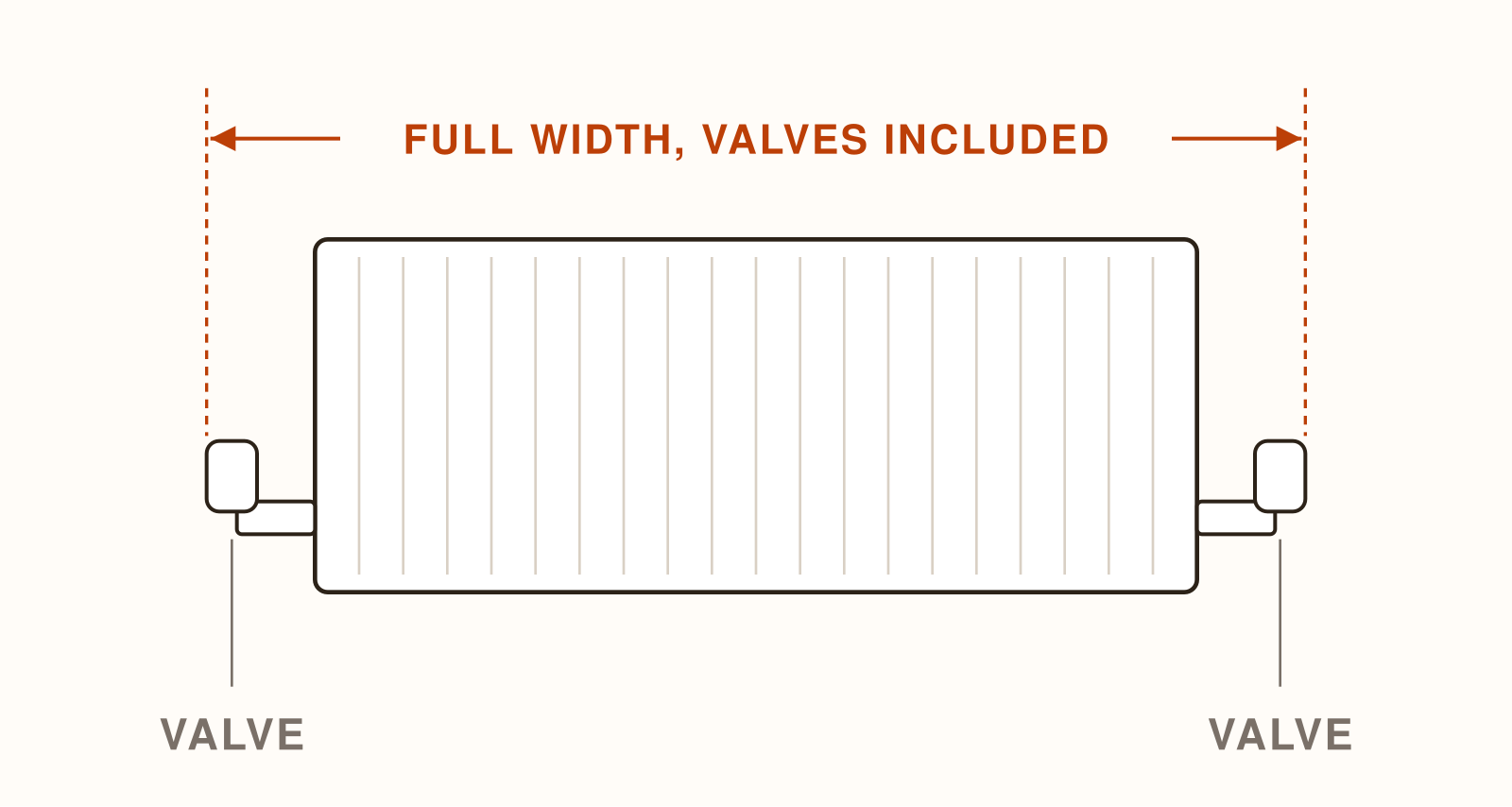
- Measure the full width, valves included. Run a tape measure straight across the radiator from the outer edge of one valve to the outer edge of the other. If one end has a cap rather than a valve, measure to the outside of the cap.
- Write it down in centimetres. Round to the nearest centimetre; you do not need to be more precise than that.
- Check the gap behind the radiator. Loby brackets need the radiator to sit at least 5cm from the wall for correct fitting and adjustment.
- Look above the radiator. Check the gap between the top of the radiator and anything directly over it, such as a windowsill.
03Choosing the right overhang
Overhang is how far the shelf extends beyond the radiator’s full width, valves included, at each end. Every Loby size leaves at least 2.5cm at each end; within that, there are two ways the shelf can read.
A close fit is when your radiator sits near the top of its size band, leaving around 2.5 to 3cm at each end. It reads as neat and tailored, and suits tighter spaces where there is little room either side.
A more generous overhang, of 4cm or more at each end, gives the shelf a deliberate, finished edge, a little like a mantelpiece. It is what you get when your radiator sits lower in its size band.
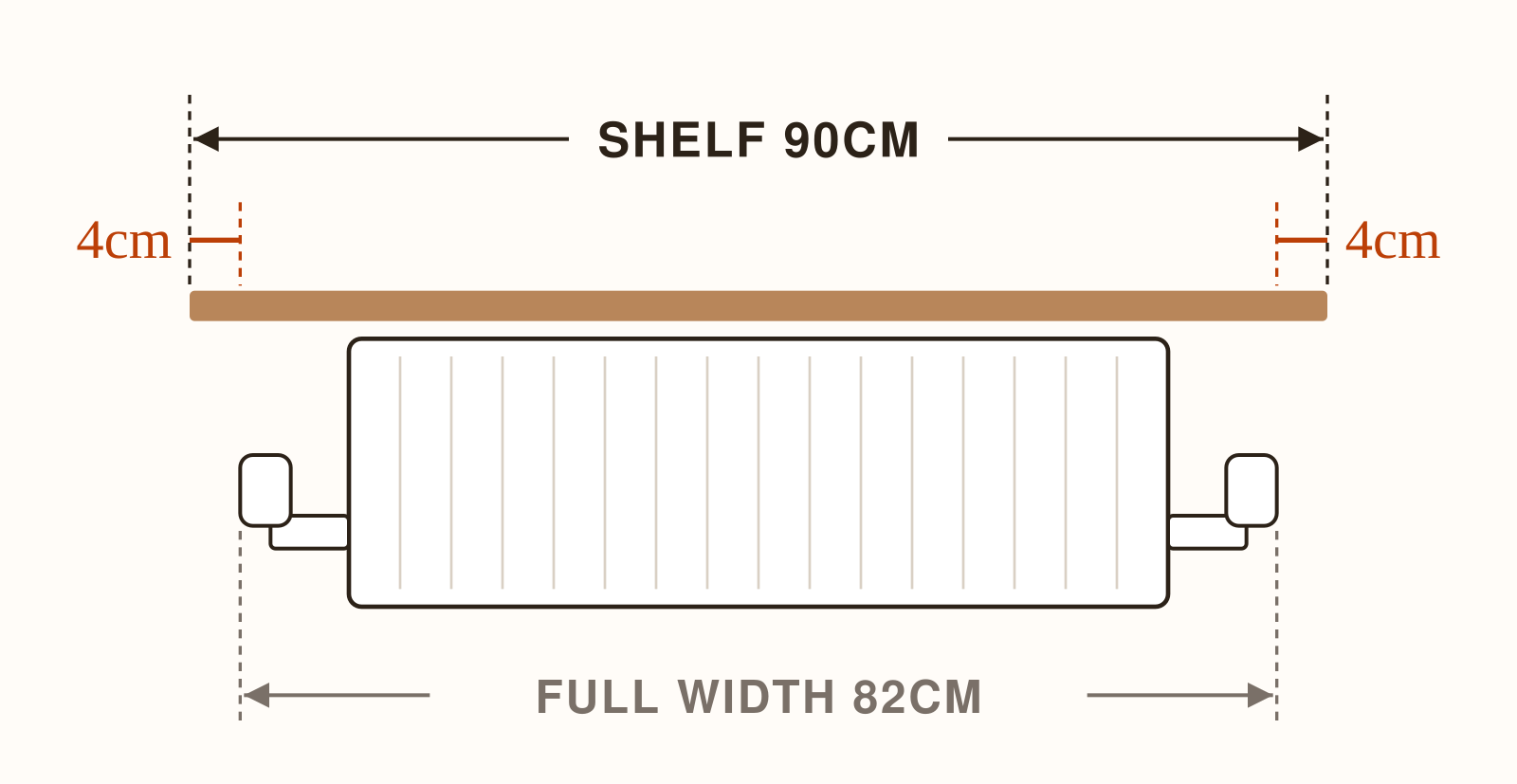
To work out your own overhang, take your full radiator width away from the shelf length and halve it.
04Check the surrounding space
The radiator tells you which size looks right. The space around it tells you whether that size will sit comfortably. Before ordering, take a look at:
- Windowsills. The shelf sits a few centimetres above the radiator, so it needs to clear a sill directly above.
- Door frames and architraves. A radiator close to a door can limit how far the shelf can extend on that side.
- Corners and side walls. A radiator tucked into a corner or alcove may only have room for a close fit.
- Plug sockets and switches. Make sure the shelf, and anything you put on it, will not block a socket or light switch.
- Furniture. A sofa, sideboard or bed nearby can change how much of the shelf you see and how much room you have.
- Curtains. Check how your curtains fall when they are drawn, and whether the shelf would sit in their way.
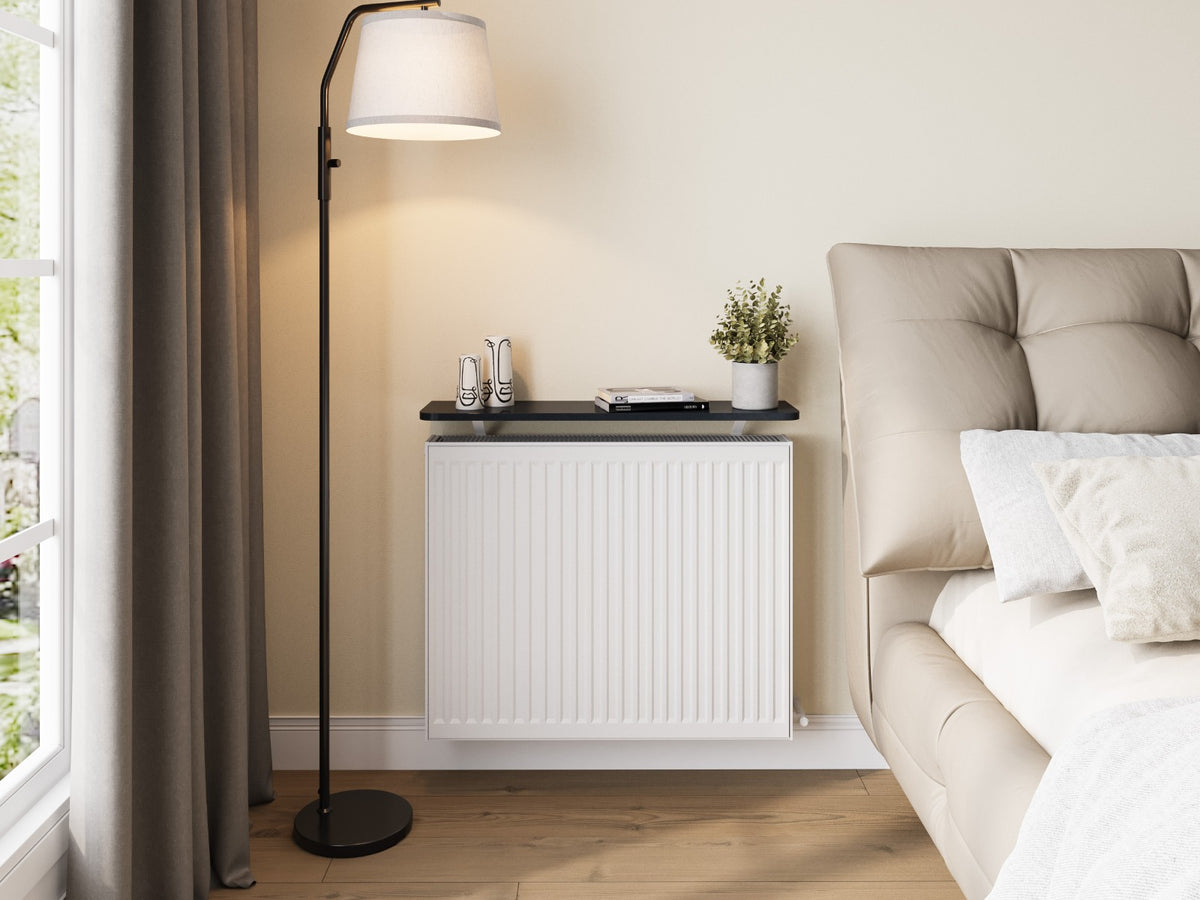
None of these usually rules a shelf out. More often, they are the reason to choose a close fit rather than a larger overhang.
05Check fitting compatibility
Radiator width and bracket compatibility are two separate questions. The width decides which size looks right; the fitting decides whether a shelf will work with your particular radiator.
Loby shelves are designed to avoid conventional wall-drilling installation. Where applicable, they use the supplied radiator-mounted brackets rather than screws into the wall: two brackets on the 40cm to 100cm shelves, and three on the 120cm and 140cm shelves, which add a centre bracket. The 60cm to 140cm shelves have two predrilled mounting positions for each bracket, 10cm apart, so the brackets can be placed to suit your radiator. You can fine-tune the height by moving the brackets forward or back.
The one firm requirement is space behind the radiator: it should sit at least 5cm from the wall. With less than that, the shelf may sit higher and there is less room to adjust it.
Not every radiator will suit every bracket, though. Standard panel radiators are the most straightforward. If you have a column, vertical, designer or unusually shaped radiator, or one fitted very close to the wall, it is worth checking before you order. Our FAQs cover fitting in more detail, and you can always send us a photo and your measurements.
06Shelf depth
Loby radiator shelves are approximately 15cm deep. For most rooms that is simply a comfortable depth for books, candles, plants and small frames.
Depth matters more in narrow spaces. In a hallway, landing or small bathroom, think about how far the shelf will project into the room: whether a door swings close to it, whether coats or bags hang nearby, and whether people regularly brush past that spot. If space is tight, keep what you style on the shelf low and close to the wall.
07Should the shelf be wider than the radiator?
Yes. Every Loby size is designed to be at least 5cm longer than the radiator it fits, measured across the valves. A shelf a few centimetres wider than the radiator at each end tends to look deliberate and finished. A shelf that stops short of the radiator tends to look as though it does not quite fit, and there is little you can do to style your way around it.
A few centimetres either side reads as intentional. A few centimetres short reads as a near miss.
In a tight space, where a wall, door frame or piece of furniture sits close to the radiator, look for the size that gives a close fit rather than a generous overhang.
08What if the radiator falls between two sizes?
You do not need an exact match, and most radiators will not have one. Shelf lengths step up in fixed sizes, so choose the shortest shelf that is at least 5cm longer than your full radiator width. A radiator 95cm wide including its valves pairs with a 100cm shelf, leaving about 2.5cm at each end. At 96cm, it moves up to the 120cm shelf.
If your radiator is only just over a band, the next size up gives a more generous overhang, around 12cm at each end in that 96cm example. That usually looks fine, but it is worth checking you have the room either side.
09Radiators beneath windows
A radiator under a window is one of the most common places for a shelf, and it can look lovely. A few practical checks help:
- Measure the gap between the top of the radiator and the underside of the windowsill. The shelf sits a few centimetres above the radiator, so it needs to fit below the sill with space for whatever you plan to put on it.
- Think about curtains and blinds. Floor-length curtains may catch on the shelf or on the objects on it; a blind that drops inside the recess is usually less of an issue.
- Keep the shelf styling low if the window opens inwards or is used often.
- Consider the proportions. Under a wide window, a shelf that matches the radiator rather than the window usually looks most balanced.
10Hallways and living rooms
Hallways
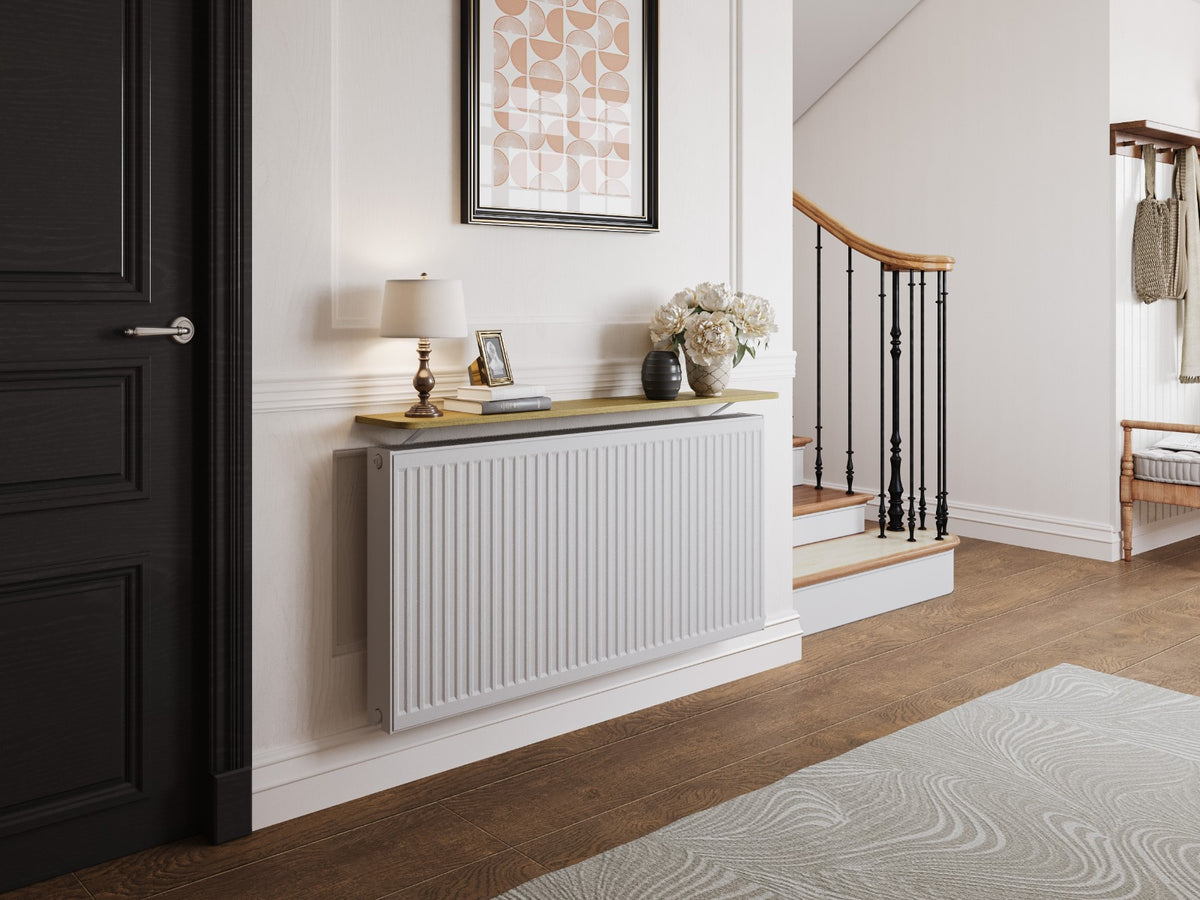
Hallway radiators are often narrow and close to doors, so measure the space either side as carefully as the radiator itself. A close fit often works best here. Keep the shelf practical, with a small tray for keys or a single plant, and leave walking room in front.
Living rooms
Living room radiators tend to have more space around them, which makes a slight overhang easier to achieve. Treat the shelf as part of the room's styling: a few books, a candle and something green, with space left between objects so it does not look crowded.
11Measuring checklist
- Full width of the radiator, valves included, in centimetres
- At least 5cm between the radiator and the wall
- Space available on each side of the radiator
- Gap between the top of the radiator and anything above it
- Nearby sockets, switches, door frames and furniture
- How your curtains or blinds fall
- Your radiator type, if it is not a standard panel radiator
- Your chosen size: the shortest shelf at least 5cm longer than your radiator
12Frequently asked questions
Do I measure the radiator or the wall?
The radiator. Measure its full width, from the outside of one valve to the outside of the other. The wall only matters for checking the space at each end and the 5cm gap behind the radiator.
Should I include radiator valves?
Yes. Loby sizes are based on the full width of the radiator including the valves, so always measure to their outer edges. If one end has a cap instead of a valve, measure to the outside of the cap.
Does the shelf need to match the radiator width exactly?
No, and it should not. Each shelf is designed to be at least 5cm longer than the radiator it fits, so choose the shortest shelf that clears your full radiator width by 5cm or more.
Can the shelf be wider than the radiator?
Yes, it always will be: every size leaves at least 2.5cm at each end. Just check you have room either side for the size you choose.
What if I am between two sizes?
Choose the shortest shelf that is at least 5cm longer than your full radiator width, then check the space at each end. If it is tight, a close fit may be the better option, so get in touch if you are unsure.
Find your fit.
Compare Loby radiator shelf sizes, styles and finishes, or use our sizing guidance to find the right option for your space.